The Income Fund in My Own Portfolio: What BST's 360% Decade Says About Tech, AI, and Getting Paid Monthly
A closed-end fund I actually own, what its track record really shows, and the income angle most investors overlook
I want to tell you about a fund I own — one that pays me every month, and one whose ten-year track record stopped me in my tracks when I was reviewing it recently. It is BlackRock's Science and Technology Trust, ticker BST. This is not a recommendation to buy it. It is a look, from someone who holds it, at how a fund like this actually works, what its numbers really say, and why the income matters more to me than the headline return.
Years ago when I first purchased BST my goal was simple: pick up a financial product that pays excellent monthly distributions while holding strong underlying companies. The companies that were held in BST have changed a bit over the years, and due to that management, the fund has experienced a growth in market price over 360% over the decade.
The number that gets your attention
Here is what caught my eye on BlackRock's own performance page. As of March 31, 2026, BST showed a ten-year cumulative NAV total return of 361.64%, and a market-price total return of 371.27% over the same period. Those are the kinds of numbers that make people lean in.
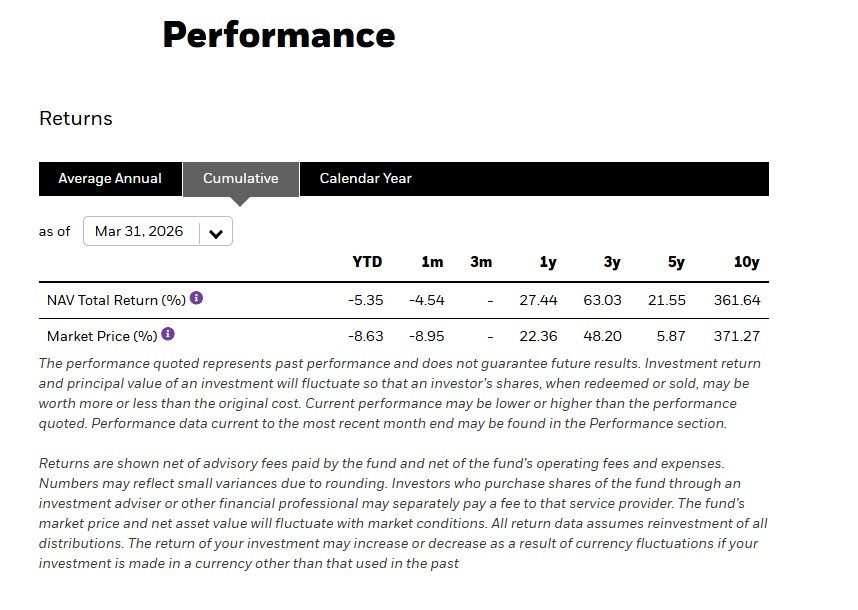
But a number like 360% over a decade only means something if you understand what is underneath it — and what the rest of the table is telling you.
The honest picture, not just the highlight
A brochure would stop at "360% in ten years." A real look does not. The price is up and down, but year to date, through May 31 2026, the fund is up 25.86%. That is the nature of a concentrated technology fund: the long-term compounding can be excellent while any given stretch is rocky. If you cannot sit through the rocky stretches, the ten-year number is not really available to you.

There is a second nuance worth understanding: the difference between NAV total return and market-price total return. A closed-end fund like BST trades on an exchange at a price that can sit above (a premium) or below (a discount) the value of what it actually holds (its net asset value, or NAV). That gap is one of the things that separates closed-end funds from ordinary ETFs, and it is something an income investor learns to watch.
What's actually inside it
BST's holdings read like a map of where technology and AI capital is concentrated right now. The top positions include NVIDIA at about 9.28%, Broadcom at 8.30%, Apple at 4.87%, , Anduril Industries at 4.56%, Databricks at 4.44%, Alphabet at 4.28%, Microsoft at 4.22%, Lam Research at 4.42%, Taiwan Semiconductor at 3.21%, and Anthropic PBC at 3.10% — with the top ten making up roughly 50% of the portfolio.
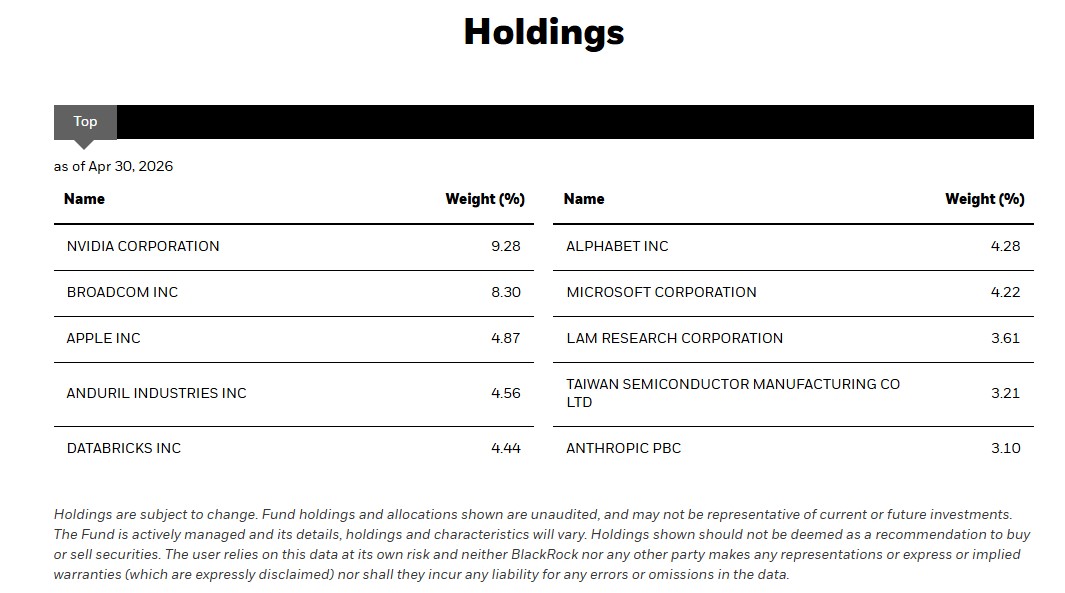
A couple of things stand out. First, the concentration: half the fund sits in ten names, so this is a focused bet on large-cap tech and the AI buildout, not a broad index. Second, the mix of public and private: alongside public giants like NVIDIA and Apple, you will notice private companies such as Databricks, Anduril, and Anthropic. That private exposure is unusual and is part of what makes BST interesting — it is a way to get a sliver of names most retail investors cannot buy directly. A private company can become quite the benefit to the fund if demand increases as an IPO approaches.
Most individual investors can't own private shares of Anthropic, but you can own a piece of it through BST. If you are still wondering if AI can really do anything valuable, consider yourself part of the experiment ~ this article was written with Anthropic's AI , Claude.
The part I actually care about: the monthly income
For me, the draw of BST is not the headline return — it is the monthly distribution. I have owned this fund for years and it pays a reliable .25 dividend per share near the end of every month. The distribution rate was 6.24% as of June 16, 2026.
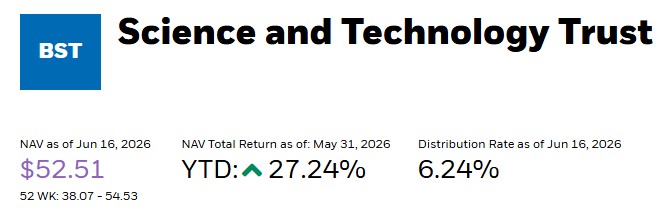
Funds like this generate income through a combination of the dividends their holdings pay and an options strategy written against parts of the portfolio, which is why the monthly payout can be meaningful.
One more thing worth mentioning, carefully. In some past years, BST has paid an additional distribution toward year end on top of its regular monthly payout. I want to be clear that I am noting this as something that has happened before, not as a promise or a stated policy — I have not found it guaranteed in the fund's official documents, and a past special distribution is no guarantee of a future one. But it is something holders may want to be aware of and watch for.
How I think about it
I use BST as part of a larger portfolio. Over the last decade it has provided significant annual returns by investing in quality public and private technology companies. It has performed quite well during that time. I hold it inside a ROTH IRA account and have the dividends set up to automatically reinvest each month. I do not see the actual cash each month, but I have certainly benefited from watching my number of shares compound over time.
BST is one fund, in one portfolio, viewed by one investor who happens to own it. Do your own research, understand what you are buying, and remember that a decade of strong returns are not guaranteed in the future.
Daily Prospector is for informational and educational purposes only and is not investment advice. Do your own research. See full disclaimer.
← back to Daily Prospector